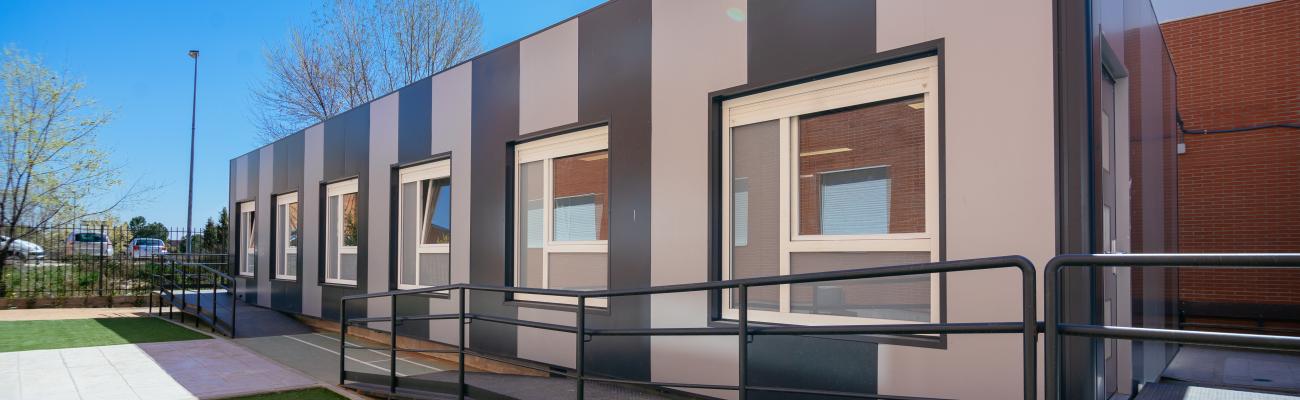

The carbon footprint of a construction site’s support facilities – does hiring skips reduce emissions, and how can this be calculated?
In tenders with environmental criteria and in ESG reports, it is very often necessary to disclose a project’s emissions, whilst construction site facilities are sometimes overlooked because it is unclear where to include them. This article explains how container hire affects the carbon footprint, where site facilities fit within the methodology, and what data to request from the supplier in order to calculate this contribution.

How does container hire affect a construction project’s carbon footprint?
Renting reduces the carbon footprint of the infrastructure, mainly through the repeated use of the same module. The emissions associated with manufacturing a container are spread across many projects, rather than being borne by a single construction site, and the rental itself reduces waste, as the module is not built from scratch or dismantled for every new project.
According to data from Algeco, modular buildings generate around half the waste compared to traditional construction, and a typical module is rented out around 20 times over its lifetime. It is precisely this frequency of reuse that makes renting a more cost-effective option than purchasing modules for a single project.

Where are the construction facilities included in the carbon footprint calculation?
Under the GHG Protocol methodology, emissions are divided into three scopes: direct (Scope 1), from purchased energy (Scope 2) and other emissions in the value chain (Scope 3). The hire of facilities itself is usually classified under Scope 3 as a service and goods acquired for the purposes of the project, although the exact category should be determined in consultation with an ESG consultant.
In the EN 15978 standard, which describes the life-cycle environmental assessment of a building, site facilities and the construction process correspond to stage A5 (construction and assembly on site). Both approaches lead to the same conclusion: site facilities are a legitimate item in the contractor’s emissions calculation, rather than an element that can be omitted.
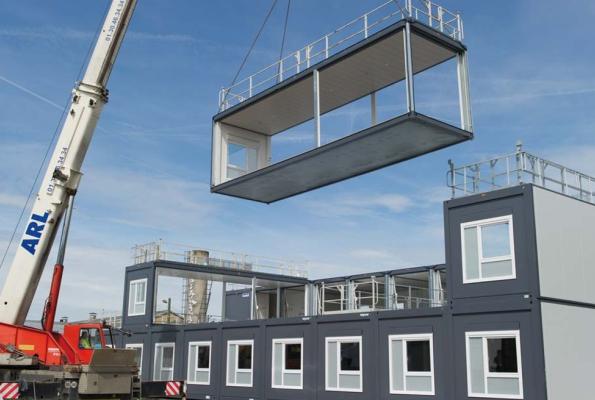
Renting, buying or a brick-built property – a comparison
The table below compares three ways of organising support facilities from an environmental and quality perspective.
|
Criterion |
Renting modules from the fleet |
Purchase of modules for 1 construction project |
A temporary brick building |
|
Material consumption |
spread across a number of tenancies |
full for a single project |
full, high |
|
Transport |
from the nearest branch |
one-off purchase and delivery |
deliveries of building materials |
|
Waste at the end |
the module returns to the fleet |
depends on the module’s future |
demolition and rubble |
|
Reuse |
multiple |
It’s possible, but it’s up to the owner |
none |
Renting works best where facilities are needed on a temporary basis, as the same module can be used on successive construction sites, rather than being demolished after a single project.

What container data should be collected for the ESG report?
To calculate the support services’ contribution to the carbon footprint, the contractor should collect a specific set of data from the supplier:
- The weight and main materials of the module (steel, panels, insulation).
- The distance and method of transport to the construction site.
- The module’s energy consumption during its operational life.
- The number of rental cycles of the module over its life cycle.
- How the module will be managed at the end of its life (reuse, material recovery).
- Any available EPD data or the module’s carbon footprint, if the supplier has this information.
Some of this data is provided directly by the supplier, whilst other details require a specific enquiry. As a company that rents out modules on a regular basis and supports construction sites from its nearest branch, Algeco can provide data on the rental cycle and logistics; it is advisable to confirm the scope of the EPD data directly.

Who is required to report their carbon footprint?
The obligation to report emissions primarily applies to large companies covered by the CSRD Directive and ESRS standards. In practice, it also affects smaller contractors indirectly – through the value chain – when a large client or investor asks a subcontractor for data for their own report.
The scope and deadlines of this obligation are subject to change, including as part of the Omnibus Package; it is therefore advisable to check the legal position as at the date of publication of the report and to cite the source. Regardless of the formal obligation, environmental criteria are appearing with increasing frequency in tender specifications – we explore the topic of support services in tenders in a separate post.

Is modular construction more environmentally friendly than traditional construction?
Usually, yes, although this depends on several factors. The advantages of modules include reusability, less waste and prefabrication under controlled conditions. However, the overall balance is negatively affected by long transport distances and high energy consumption during use, particularly where insulation is poor.
Therefore, the actual environmental footprint is determined not by the technology itself, but by how it is used: repeated rental rather than purchase for a single project, good insulation and energy-efficient fittings. We describe the impact of energy consumption on the environmental footprint in an article on electricity in a container, and the principles of reuse in the post on the environmental benefits of modular technology.
Myths about the environmental impact of containers
Myths have arisen around modular construction which raise doubts about its environmental impact. The first is that a module is a single-use structure; however, in the rental model, it serves many construction sites and is therefore reusable. The second is that a container is always energy-intensive. In reality, energy consumption depends on insulation and fittings, not on the structure itself. Other myths, including those unrelated to environmental issues, have been compiled in the post 7 myths about modular construction.

How to reduce emissions from support operations in practice
The biggest difference comes from choosing to hire rather than buy modules for a single project, as this is what enables reuse. Added to this is tailoring the size of the site facilities to actual needs – oversized facilities mean wasted energy and materials; we describe this planning method in our article on construction site facilities.
The next steps involve energy-efficient equipment and on-site energy sources, including photovoltaic panels on a container, as well as logistics from the nearest branch, which reduces transport distances. Algeco serves construction sites from eight locations across Poland, which helps to minimise the distance over which modules are delivered.
FAQ
Is renting containers more environmentally friendly than buying them? For temporary projects, this is usually the case, as the same module is reused multiple times, and the emissions from its production are spread across many construction sites. According to Algeco’s data, a module is rented out around 20 times over its lifecycle. When used for many years in a single location, the situation is different.
Under which emissions category should rented containers be reported? Most commonly under GHG Protocol Scope 3, as a service and goods acquired for the purposes of the project. It is worth determining the exact category with an ESG consultant, as it depends on the accounting method.
How many times can a single container be rented out? According to Algeco’s data, a typical module is rented out around 20 times over its lifecycle. It is precisely this reusability that reduces its carbon footprint per project.
Are the containers recyclable? The main materials of the module, such as steel and panels, are recoverable, and under the rental model, the module itself returns to the fleet and continues to be used. It is worth confirming the specific end-of-life management procedure with the supplier.
What is stage A5 in EN 15978? This is the on-site construction and assembly stage in the life-cycle environmental assessment of a building. Emissions associated with the construction site are most commonly attributed to this stage.
Does Algeco provide data for the ESG report? Algeco can supply data on the module’s rental cycle and delivery logistics. The scope of other data, including any EPDs, should be agreed directly with the company.