
How much electricity does an office container need? Power, connection, air conditioning and energy costs
Before ordering a temporary power supply or a generator, you need to know how much power to allow for the site facilities. Underestimating the power requirement will cause circuit breakers to trip, whilst overestimating it will result in unnecessary costs for the connection. This article explains which appliances consume the most energy, how to calculate the power requirement for the entire set of site huts, and where to source electricity on site.
How much electricity does an office container use?
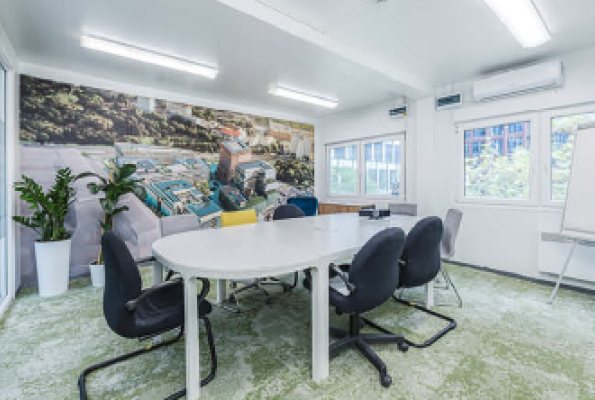
A single office module consumes the most energy on heating and cooling – these are the main factors determining the energy balance, rather than lighting or office equipment. In Algeco units, electric heating has a power rating of around 2–2.5 kW per unit and is the main power consumer in winter; in summer, this role is taken over by air conditioning. Other power consumers – lighting, sockets and IT equipment – account for a much smaller proportion.
Actual demand depends on the time of year, the module’s insulation and its fittings. Therefore, the power requirement for the facilities is calculated based on the total of all loads, rather than a single fixed figure.
Which appliances use the most energy?
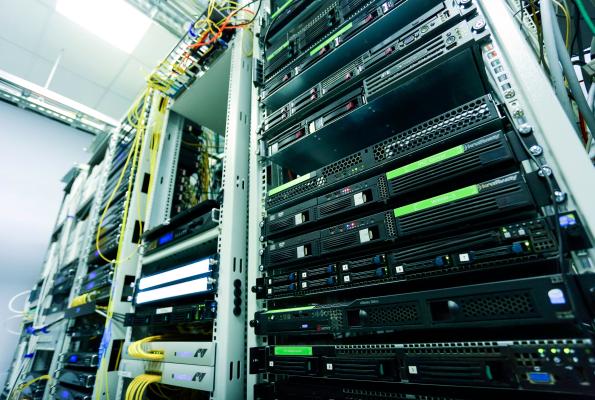
The table below lists typical electrical appliances found in containers, together with their approximate power ratings. The figures for heating and lighting are taken from Algeco’s module specifications; those for the air conditioner and water heater depend on the model.
|
Consumer |
Power |
Note |
|
Electric heating (1 module) |
2-2,5 kW |
the main consumer in winter |
|
Air Conditioning |
depending on the model, in the range of 1–2.5 kW |
the main consumer in summer |
|
Lights |
in the range of 70–150 W per module |
LED or fluorescent |
|
Water heater (sanitary module) |
depending on the model, in the range of 1–2.5 kW |
only in sanitary odules |
|
Sockets, office equipment, IT |
depending on the equipment |
computers, kettle, server |
Practical conclusion: heating and air conditioning account for the bulk of the energy consumption. The boiler in the sanitary module and the IT equipment contribute to the peak, particularly when they are running at the same time.
How to calculate the power requirement for a set of containers
The power requirement for the set is calculated in three steps, rather than by simply adding up the power of all the appliances.
- Add up the rated powers of all the appliances in the modules.
- Apply the simultaneity factor – not all appliances operate at full power at the same time.
- Add a margin and, on this basis, select the connection capacity and protective devices.
An indicative example for a setup comprising 2 offices + 1 staff room + 1 toilet block: heating alone is around 10 kW (four modules of 2–2.5 kW each), plus lighting, a water heater and IT equipment. The total nominal power amounts to a dozen or so kW, but when the simultaneity factor is taken into account, the actual demand is lower. The specific connection power and choice of protective devices are determined by a qualified electrician, as they depend on the degree of simultaneous operation and the reserve capacity for future expansion of the facilities.
Where to get electricity for the site offices: a mains connection, a switchboard or a generator
The site facilities are powered from one of three sources, depending on whether there is already electricity on site and for how long.
|
Source |
When it works |
What to watch out for |
|
Temporary connection from the distribution system operator (DSO) |
longer construction projects, a reliable and cheaper power supply |
application and waiting time for connection |
|
Construction switchboard from the site mains supply |
when the power is already on site |
selection of the power rating of the switchboard for the support facilities |
|
Generator set |
off-grid site, short-term, reserve |
selection of power (kVA) with a margin, fuel cost |
For longer-term projects, a temporary connection from the network operator is usually the best option, whilst a generator is suitable where there is no mains supply or where a backup is required.
How to connect the units to the mains and to one another
Container units are usually powered by a 400 V three-phase supply, and the modules are connected together to form a single circuit. The installation requires earthing and residual current devices (RCDs), and once installed, tests must be carried out to verify protection against electric shock. The connection and testing must be carried out by a qualified electrician.

Can an office container be fitted with air conditioning, an IT network and a server room?
Yes. An Algeco office module can be fitted with air conditioning, structured cabling, Wi-Fi access points and a rack-mounted server cabinet. However, it is important to bear in mind that air conditioning and the server increase power consumption and require cooling; therefore, their inclusion affects the energy balance of the entire unit.
The equipment and technology are described on the page air-conditioned office containers, and as part of the service – under 360° Service – energy and technology.

How much does electricity cost in a container each month?
The monthly energy cost is your consumption in kWh multiplied by the rate per kWh specified in your contract or tariff. Consumption depends primarily on heating and air conditioning, which is why it is significantly higher in winter and summer than during the transitional periods.
In practice, the cost is estimated as follows: estimate the daily operating hours of the main appliances (heating or air conditioning), convert these into monthly kWh and multiply by the current rate. With electric heating of around 2–2.5 kW per module, this is what accounts for the bulk of the bill during the heating season. Instead of using a pre-calculated figure, it is worth using your own tariff, as energy prices vary between contracts and change over time.
How to reduce energy consumption in a container
Insulation has the greatest impact on energy consumption. The lower the U-value, the less energy is lost – in Algeco modules, the U-values range from approximately 0.21 to 0.44 for the roof, from approximately 0.24 to 0.35 for the floor, and for walls from approximately 0.22 to 0.57 W/m²K, depending on the module version. The impact of the structure on energy consumption is described in the post construction of an office container.
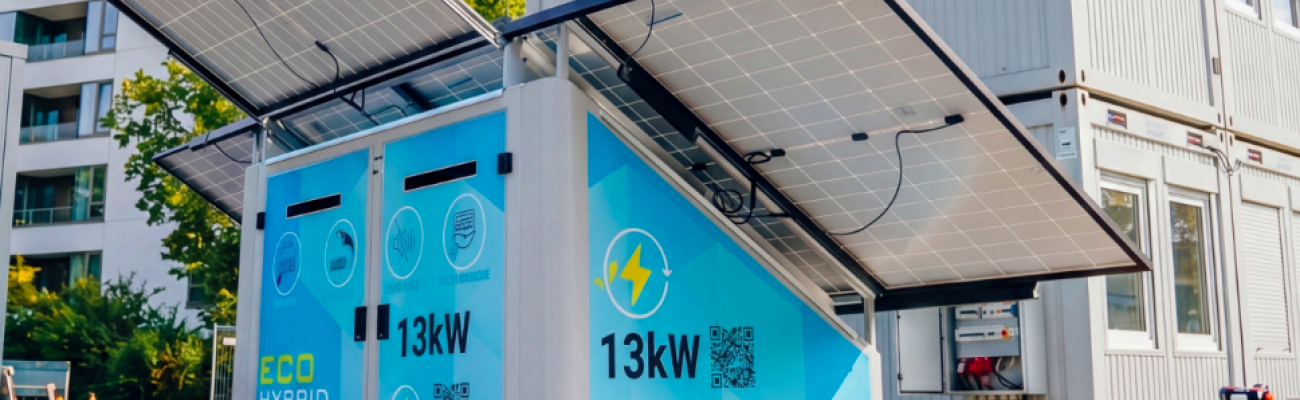
In addition to insulation, energy consumption is reduced by: energy-efficient heating and its control systems, selecting air conditioning appropriate to the volume of the space, as well as solutions provided by the supplier. The selection and types of heating are described in the post ‘Container heating’, whilst on-site energy generation is covered in the post ‘Photovoltaics on a container’.
FAQ
Can an office container be connected to a standard 230 V socket? A single module with a low load may be powered by a single-phase supply, but a cluster of several modules with heating, air conditioning and IT equipment usually requires a 400 V three-phase installation. The selection of the power supply for a specific cluster is a matter for an electrician.
Which generator should you choose for an office container? The generator’s power (in kVA) is selected based on the total load of the electrical appliances, with a margin to cover peak demand and future expansion. A generator that is too small will become overloaded, whilst one that is too large will result in higher costs and fuel consumption.
Who connects the container to the mains? The connection and measurements are carried out by a qualified electrician. The scope of work to be carried out by the supplier is agreed upon at the time of ordering.
Is air conditioning standard in an office container? An Algeco office module can be fitted with air conditioning that includes a heating function. In staff facilities, air conditioning is often an optional extra chosen to suit requirements.
How much does it cost to heat a container in winter? It depends on the heating output (around 2–2.5 kW per module), the number of operating hours and the energy tariff. The cost is calculated as consumption in kWh multiplied by the tariff; more on selecting heating systems in a separate post.
Can a server room be housed in a container? Yes – the module can be fitted with a rack and an IT network. However, additional power and cooling must be provided, as the server operates continuously.