
What is the best way to heat a container effectively?
Modern office containers, staff facilities and residential containers are increasingly being used all year round, including in winter. Although a steel structure may seem to pose a challenge in terms of thermal comfort, modern technologies and the right equipment make it possible to heat a container effectively even in the most demanding weather conditions. Below, we explain how to heat a container and which solutions are most commonly used.
Is the container suitable for use in winter?
Yes, provided that appropriate technical solutions are implemented. The containers offered by Algeco feature mineral wool thermal insulation, which significantly reduces heat loss. Combined with modern heating systems, the container can easily be adapted for year-round use. In practice, this means that an office or staff room container can be used in winter without compromising user comfort.
The effectiveness of the heating is influenced by, amongst other things:
- the quality and thickness of the thermal insulation,
- the module’s surface area and the number of glazed sections,
- the type of heating system used,
- the intended use (temporary or year-round).
Proven heating solutions in Algeco containers
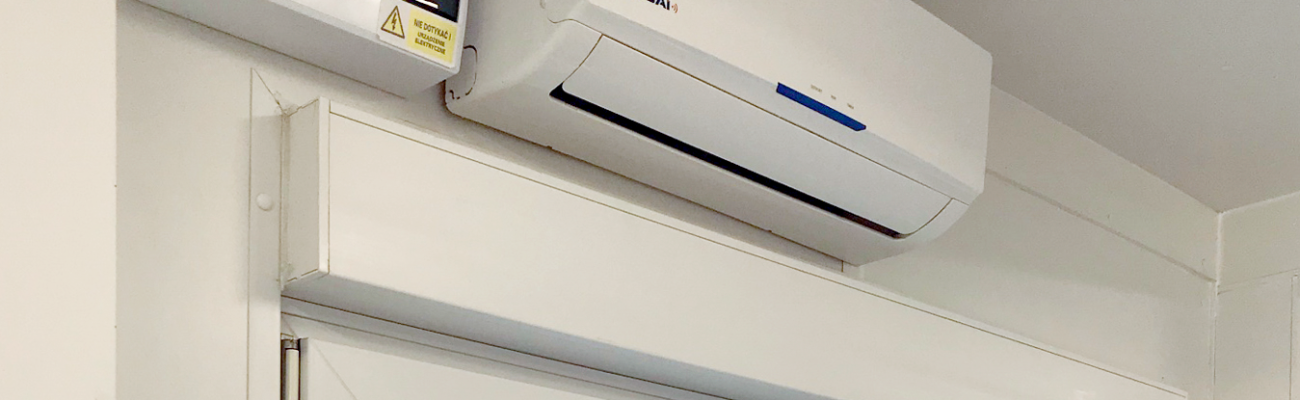
In the containers offered by Algeco, we primarily use electric heating, which guarantees reliability, quick installation and ease of use. As an optional extra, it is also possible to fit the container with air conditioning units with a heating function, which perform well all year round – both in winter and summer. Thanks to appropriate mineral wool insulation and the precise tailoring of the fittings to the customer’s needs, our containers ensure thermal comfort in all conditions. For office containers, the average electricity consumption is around 2.5 kW, whilst for sanitary containers it can be as high as 6 kW, depending on the number of connected appliances and the manner of use.
Other heating technologies are also available on the market, such as storage heaters or central heating systems with a gas boiler. However, for temporary and mobile solutions, electric heating remains the most versatile and efficient choice.
How do you choose the right heat source for a given type of container?
The choice of container heating system should depend on:
- the size of the container,
- the level of thermal insulation,
- the mode of operation (temporary vs. continuous),
- and the availability of an electricity supply.
For a standard office container with an area of approx. 15 m², a heat demand of 100 W/m² can be assumed, which gives a heating power of 1.5 kW. In the case of sanitary containers or structures with a large amount of glazing, it is recommended to oversize the unit or use additional heat sources.
What else improves thermal comfort inside a container?
Container heating is not the only factor. Thermal comfort in a container is also influenced by:
- airtight windows and doors,
- an insulated roof and floor,
- additional window coverings (roller blinds, venetian blinds),
- the appropriate positioning of the container in relation to sunlight,
- the use of thermostats and temperature sensors.
Turnkey solutions from Algeco
Algeco is a supplier and manufacturer of modular containers, offering comprehensive project delivery – from design through to delivery and configuration of the finished facility. Our office and staff facilities are fitted as standard with mineral wool insulation and, at the customer’s request, can be retrofitted with heating systems, air conditioning, electrical installations, IT systems or photovoltaic panels.
As part of our 360° service, we provide full technical and logistical support – both prior to delivery and during the operation of the modules. This means not only rapid assembly and flexible adaptation of the containers to the customer’s needs, but also servicing, maintenance and dismantling where required. As a result, Algeco delivers not just a product, but a complete, ready-to-use infrastructure – without any unnecessary complications.