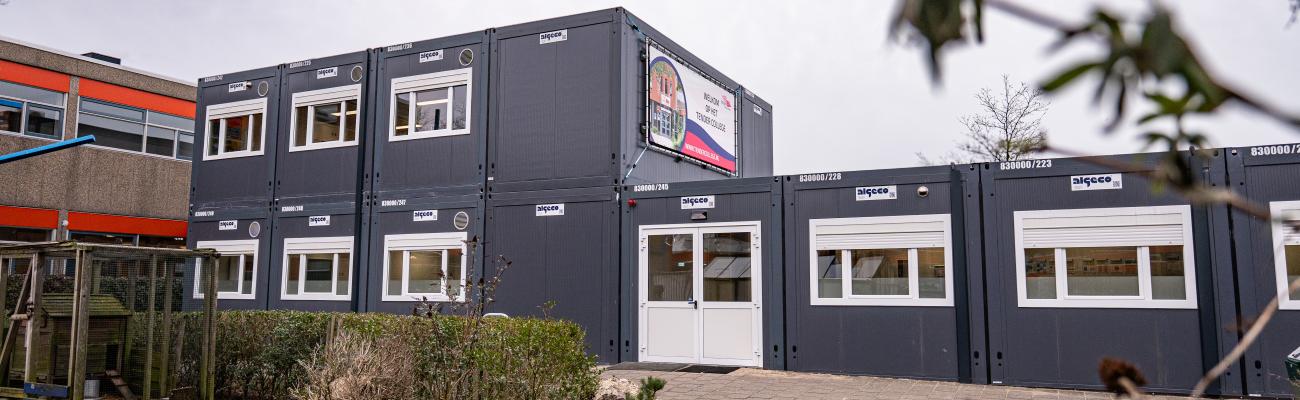

Types of containers – an overview of types and uses
The term ‘container’ encompasses many different structures, the only things they have in common being their cuboid shape and modular design. In practice, transport, office, sanitary and residential containers are entirely different products, designed for different purposes and with different specifications. Choosing the right type determines whether the solution will fulfil its purpose and prove cost-effective. This article categorises the different types of containers according to their function and application. It explains how the various types differ, what they are suitable for, and which ones can be hired and which ones purchased. It serves as a starting point for anyone considering acquiring a container and wishing to explore the available options.
How do we classify containers? Basic categories
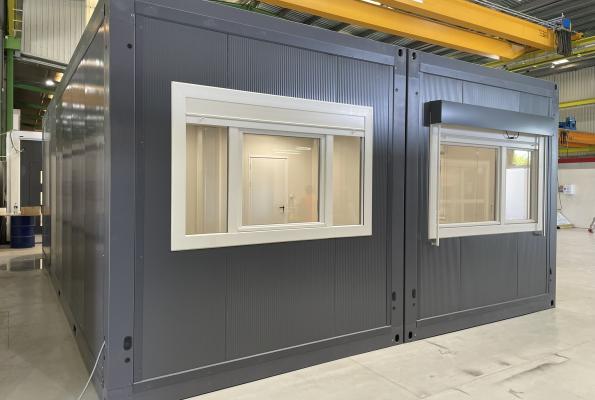
The most important distinction is between transport containers and modular containers. Transport containers – that is, shipping containers – are used for the transport and storage of goods. They are made of weather-resistant steel, are subject to transport standards and are not suitable for human occupancy without costly adaptation. Modular containers, on the other hand, are designed as usable spaces – with insulation, windows, services and finishes to ensure comfort.
Within the category of modular containers, we distinguish further types according to their intended use: office, staff facilities, sanitary, residential, retail, catering, storage and technical. Each type features specific fittings tailored to its function. A second criterion for classification is the method of acquisition – hire or purchase – and the duration of use, ranging from event projects lasting a few days to long-term investments. Mobile containers can be moved and repositioned, which distinguishes them from structures permanently anchored to the ground.
Office containers – mobile workspaces
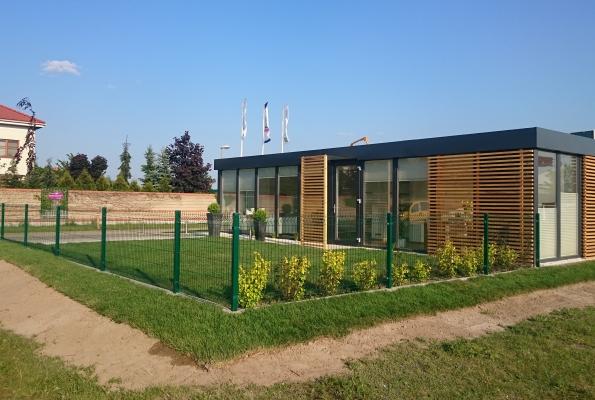
Office containers are modules designed for office work, fitted with lighting, heating, electrical installations and, where required, air conditioning and an IT network. They are ideal as temporary offices, administrative facilities on building sites, customer service points or security posts. Their main advantage is how quickly they can be set up – a module is ready for use immediately after assembly.
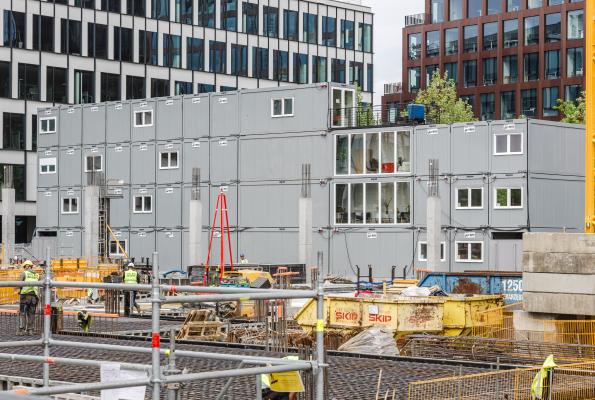
A standard office module measures 6055 × 2435 × 2790 mm, providing approximately 14 m² of floor space, and weighs an average of around 2 tonnes. A single module is sufficient for several people, whilst combining units allows for the creation of larger offices, conference rooms and administrative complexes, including multi-storey ones. Thanks to partition walls, the interior can be divided into sections with different functions.
Office containers are available for both hire and sale. Renting is ideal for temporary and seasonal projects, whilst purchasing is suitable when permanent facilities are required. Algeco’s modular solutions include offices with various finishes, which can be fitted out with furniture and additional installations. The fit-out is available in three variants – Economy, Comfort and Premium – allowing the standard to be tailored to the nature of the work and the budget.
Social containers and toilet facilities – essential on a construction site
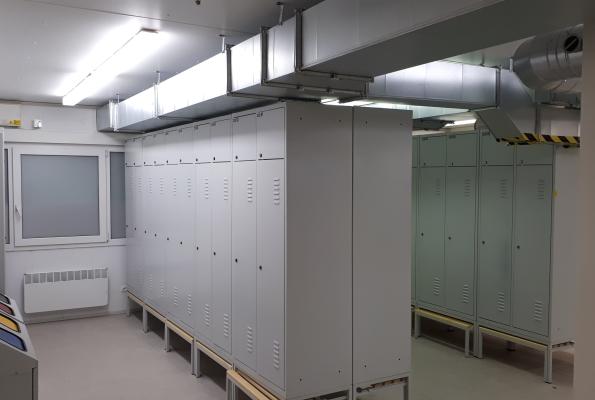
Welfare and sanitary units form the basis of on-site facilities at construction sites and industrial premises. A welfare unit serves as a changing room, canteen and rest area – equipped with lockers, tables, heating and lighting, it provides staff with the facilities they need to change, have a meal and rest. Sanitary containers house toilets, washbasins and showers connected to the water and drainage systems.
The hire of welfare containers accounts for the majority of projects carried out by Algeco, reflecting the widespread need to organise facilities in accordance with health and safety requirements. A sanitary module has higher energy requirements – approximately 6 kW compared to 2.5 kW for an office module – and is heavier, at around 4 tonnes, due to its fittings and fixtures.
Sanitary containers can operate using permanent connections or via water and waste tanks, which allows them to be installed even where there is no access to the mains drainage system. This flexibility makes them an essential component of site facilities on construction projects carried out in various locations. We discuss the organisation of staff facilities in more detail in our article on changing room containers.
Residential containers – modular solutions for year-round use
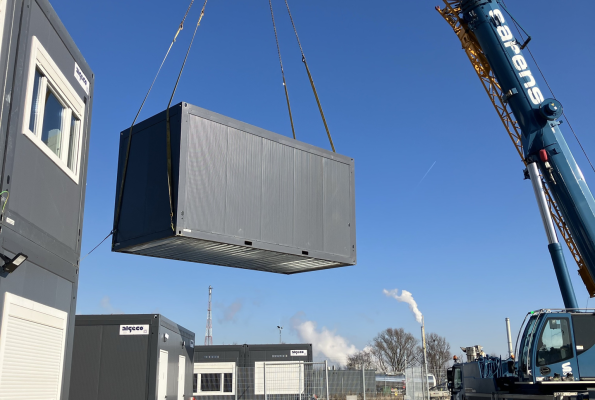
Residential containers are modules designed for long-term human habitation, featuring adequate thermal and acoustic insulation, heating and sanitary facilities. They are used to house workers on large-scale construction projects, as temporary accommodation or as overnight accommodation in locations remote from urban amenities.
Unlike makeshift huts, modern residential modules offer a level of comfort similar to that of a standard flat. The insulation allows for year-round use, whilst combining modules enables the creation of larger complexes with separate rooms, communal areas and sanitary facilities. This solution works well where a team is working for an extended period away from home.
The modular design allows the accommodation base to be scaled up or down as required and moved on once the project is complete. As a result, the client avoids the costs of constructing permanent buildings which would become redundant once the project is finished.

Retail and catering containers – business in a modular format
Retail and catering containers are used for retail and service activities. A retail module can serve as a shop, showroom or ticket office, whilst a catering module can function as a café, street food bar or event stall. A common feature of both is their attractive appearance, made possible by glazing and the customisation of the façade.
Catering operations impose additional requirements – access to water, waste water drainage, ventilation and back-of-house facilities compliant with health and safety regulations. Containers for catering use can be configured to suit a specific sales profile. For outdoor events, event modules are ideal, serving as catering, ticketing and service points.
The advantage of container-based solutions in retail and catering is their mobility and flexibility. A unit can be set up seasonally, moved to a busier location and rented only for the duration of operations, which reduces risk and better aligns costs with revenue.
Technical and storage containers
Technical and storage containers are used to store equipment, materials and apparatus, and to house technical installations. A storage module provides a lockable, secure space, whilst a technical container can house equipment, switchboards or service facilities. Unlike rooms intended for people, their priority is functionality and the security of their contents.
Storage containers are ideal for use on building sites, in industrial premises and in the retail sector as a complement to core business activities. They help to organise storage and protect valuable equipment against theft and the elements. Their modular design allows the size of the storage facility to be tailored to specific needs and expanded as the business grows.

Shipping and transport containers – how do they differ from modular containers?
Shipping and transport containers constitute a separate category, designed for the transport and storage of goods. Made of corrosion-resistant steel, they comply with transport standards and are suitable for handling and stacking. However, they lack insulation and interior finishes, and are therefore unsuitable for use as living spaces without adaptation.
The main difference between a shipping container and a modular container lies in their intended use. Shipping containers are used for logistics, whilst modular containers are designed for people. Once insulated and adapted, a shipping container can serve as a storage facility on a construction site, but a ready-made modular unit is far better suited for use as an office, staff facilities or a service point. We have provided a detailed comparison of both types, along with their standard dimensions, in a separate blog post. Algeco focuses on modular solutions and does not offer shipping containers.
How do you choose the right type of container?
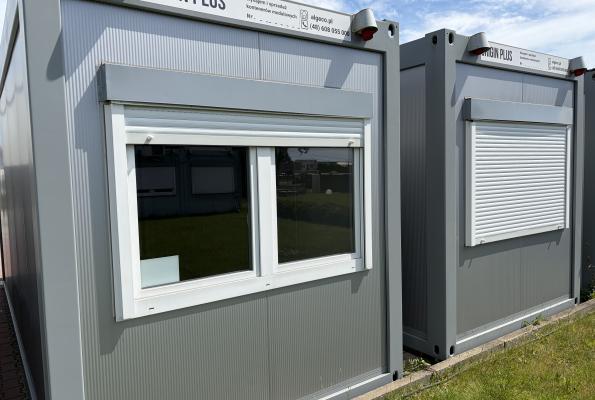
Choosing the right type of container starts with determining its intended purpose and the number of people who will be using it. One type of container is suitable as an office, another as a toilet block, and yet another as a storeroom. The table below categorises the main types of containers according to their intended use and availability in Algeco’s range.
|
Container type |
Main use |
In Algeco offer |
|
Office |
Temporary offices, administration, site offices |
Yes (rent and sale) |
|
Social |
Changing rooms, canteens, staff facilities |
Yes (rent and sale) |
|
Sanitary |
Toilets, showers, washbasins |
Yes (rent and sale) |
|
Residential |
Employees' accommodation |
Yes |
|
Retail / catering |
Shops, cafes, event points |
Yes |
|
Technical / storage |
Storage of equipment and materials |
Yes |
|
Marine / transport |
Transport and storage of goods |
No |
The second criterion is the duration of use and the method of acquisition. Temporary and seasonal projects favour renting, whilst long-term investments may justify purchasing. It is also worth considering the possibility of combining modules if you are planning to expand. If in doubt, it is best to discuss your requirements with an Algeco representative, who will help you select the type and configuration best suited to your specific application.
FAQ – types of containers
What are the main types of containers?
The basic distinction is between transport (seagoing) containers and modular containers. Among modular containers, we distinguish between office, staff facilities, sanitary, residential, retail, catering, technical and storage containers. Each type is equipped to suit its function, and the modules can be combined to form larger structures.
How does a modular container differ from a shipping container?
A shipping container is used for the transport and storage of goods; it is made of steel without insulation and requires adaptation to its intended use. A modular container is designed as a space for people – it features insulation, services and finishes, and is ready for use once assembled. Modules can also be combined to form larger, multi-storey buildings.
Which containers can be hired, and which can only be bought?
Algeco modular containers – office, staff facilities, sanitary and others – are available for both hire and sale. Hiring is suitable for temporary and seasonal projects, whilst purchase is recommended when permanent facilities are required. The choice of option depends on the duration of use and the nature of the project.
Can different types of containers be combined?
Modular containers can be combined in horizontal and vertical configurations to create larger structures with varied functions – for example, office and staff facilities complexes. Thanks to partition walls, the interior is divided into sections. Algeco constructs modular structures of up to three storeys, combining modules with different purposes into a single structure.
Which container should you choose for a construction site with 10 workers?
For a team of around 10 people, you’ll need staff and sanitary facilities – a staff container serving as a changing room and canteen, and a sanitary container with toilets and showers. The number and size of the modules are selected according to the size of the team and health and safety requirements. It is advisable to discuss the optimal configuration with an Algeco representative.