

A water tank – what is it used for and how do you choose a tank for a building site?
A ‘Mauzer’ is one of the most common items of equipment found on building sites, in industrial plants and on farms. This colloquial term refers to an IBC container – a container with a capacity of around a thousand litres, used for the storage and transport of liquids. Despite its widespread use, the ‘mauzer’ is sometimes mistakenly regarded as a complete water and sanitation solution, whilst in reality it serves only as a storage tank. This article explains what a ‘mauzer’ is, its specifications and applications on a construction site, as well as what is required to provide staff with full water and sanitation facilities. It also highlights where the function of the tank itself ends and the need for comprehensive welfare facilities begins.
What is an IBC? Design and uses
A Mauzer, technically referred to as an IBC (Intermediate Bulk Container), is a tank consisting of a plastic container housed within a protective metal cage, mounted on a pallet. This design ensures stability, facilitates transport by forklift and protects the container from mechanical damage. There is a drain valve at the bottom of the container and a filling port with a cap at the top.
Mauzers are used for the storage and transport of various types of liquids – water, technical fluids and chemicals. Due to their versatility and relatively low cost, they are widely used in industry, agriculture, logistics and on construction sites. Their popularity stems from their handy dimensions, which allow for easy positioning and movement of the full tank.
Mauzer 1000l – the most popular size and its specifications
The most common type is the 1,000-litre Mauzer tank. Its standard dimensions are approximately 120 × 100 cm at the base and approximately 116 cm in height, which correspond to the dimensions of a pallet and facilitate transport and storage. An empty tank weighs several dozen kilograms, whilst when filled with water it weighs over a tonne, which requires a stable, level surface.
Mauzer tanks are available in new and reconditioned versions. New tanks are suitable for contact with drinking water and food, provided they have the appropriate certifications. Refurbished tanks – that is, used and cleaned tanks – are cheaper, but their previous contents are important: a container that has held chemicals is not suitable for storing water intended for consumption. When making a choice, it is worth paying attention to the tank’s history and its intended use.
Mauzers on a building site – what are they used for?
On a building site, the Mauzer serves as an auxiliary liquid storage tank. Its mobility and capacity make it ideal for use where there is no permanent water connection or where a temporary water supply is required. The tank can be positioned anywhere and moved to another location if necessary.
However, it is worth bearing in mind that the Mauzer is merely a container. It does not provide a running supply of pressurised water, nor does it filter the water or handle waste water disposal. It serves a storage function, which must be supplemented by other infrastructure elements if the water is to be used by workers for hygiene or welfare purposes.
Tank for drinking water, service water and fire-fighting water
A Mauzer tank can store water for various purposes. Service water is used for construction work – mixing mortar, wetting surfaces and cleaning. Drinking water requires a tank with the appropriate certification and careful attention to cleanliness, as water left standing in an unsuitable container quickly becomes unfit for consumption. Mauzer tanks are also sometimes used as part of fire-fighting equipment, serving as a water reserve.
Each of these uses places different demands on the tank. A clean, certified container is essential for drinking water, whilst a reconditioned tank is sufficient for service water. Mixing these uses without maintaining hygiene leads to water contamination; therefore, the tank’s intended use must be determined in advance.
Mauzer as a temporary wastewater tank
A Mauzer is also sometimes used as a makeshift tank for sewage or greywater. However, this is only a temporary solution and is limited by the tank’s capacity. With regular use, particularly by a large number of workers, the 1,000-litre capacity is quickly exhausted, and the tank requires frequent emptying.
For this reason, a Mauzer cannot replace proper sanitation facilities. Where toilets, showers and washbasins are required for staff, the tank alone is not sufficient – facilities are needed to ensure the ongoing management of water and wastewater.
What Mauzer cannot replace – comprehensive construction facilities
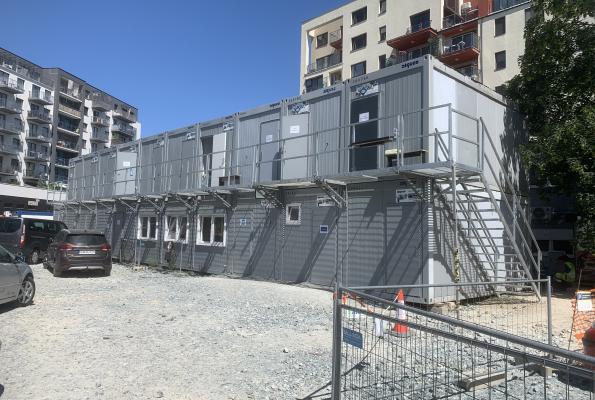
Mauzer solves the problem of water storage, but does not provide welfare facilities. Construction site workers need access to toilets, washbasins, showers and areas where they can change and eat their meals. No water tank can provide these facilities – they require sanitary and welfare containers connected to the plumbing system.
A comprehensive water and sanitation facility combines a water tank with modules where the water is actually used. This approach ensures hygienic conditions for workers and enables compliance with health and safety requirements regarding on-site facilities.
Sanitary container with toilet and shower
A sanitary container is a module equipped with toilets, washbasins and showers, connected to the water and drainage system. It provides staff with hygienic conditions regardless of whether the construction site has access to a permanent drainage system. Algeco sanitary containers can operate using either mains connections or on-site tanks, which means they can also be installed in areas not served by the mains network.
The average electricity consumption of a sanitary module is around 6 kW, and it weighs approximately 4 tonnes, due to the fittings and fixtures installed. It is a fully-fledged sanitary facility that a portable toilet alone cannot replace.
Welfare container – changing room and canteen for workers
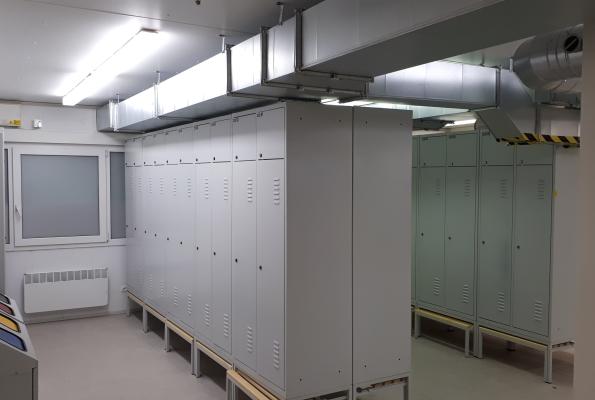
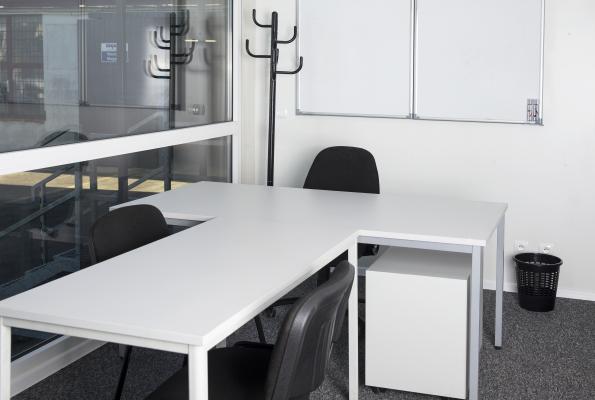
The welfare container serves as a changing room, canteen and rest area for the construction crew. Equipped with lockers, tables, heating and lighting, it provides workers with a place to change, eat and rest between shifts.
The hire of welfare containers accounts for the majority of projects carried out by Algeco, meeting the widespread need for on-site facilities at construction sites. Welfare modules can be combined and configured depending on the size of the crew. Together with a sanitary container, they form a complete facilities package, in which the water tank is just one component, rather than the entire solution.
How do you organise water and sanitation facilities on a building site?
It is worth starting the planning of the site facilities by determining the number of workers and the duration of the construction work, as this will determine the number of sanitary and welfare modules required, as well as the capacity of the water tanks. The larger the workforce, the greater the demand for toilets, showers and dining areas.
The next step is to check the availability of utilities. Where there is a water and sewerage connection, the modules are connected directly to the mains. Where this is not available, clean water and waste water tanks are used, which are emptied by a waste disposal company. The most convenient solution is a comprehensive service from a single supplier. Algeco’s 360° Service covers transport, assembly and technical maintenance of the facilities, which eliminates the need to coordinate multiple contractors. In such a setup, a ‘Mauzer’ can serve as an auxiliary tank, but the core of the facilities consists of sanitary and staff containers.
FAQ – Water-powered Mauzer
How many litres does a standard Mauzer hold?
A standard Mauzer has a capacity of 1,000 litres and is the most popular size. Its dimensions correspond to those of a pallet – approximately 120 × 100 cm at the base and 116 cm in height – which makes it easy to transport and store. Mauzers with smaller capacities are also available, for example 600 or 800 litres.
Is a Mauzer suitable for storing drinking water?
Only a new mauzer, certified for contact with food and kept clean, is suitable for storing drinking water. Refurbished tanks, particularly those previously used for chemicals, are not suitable for this purpose. It should also be borne in mind that water left standing in a tank becomes unfit for consumption over time, so it must be replaced and hygiene must be maintained.
How does a new tank differ from a reconditioned one?
A new tank is a factory-clean container which, having the appropriate certification, is suitable for contact with drinking water and food. A reconditioned Mauzer is a used container that has been cleaned and prepared for reuse – it is cheaper, but its suitability depends on its previous contents. A reconditioned container is suitable for non-potable water, whilst a new and certified one is required for drinking water.
How do you dispose of an old Mauzer?
A worn-out Mauzer should be taken to an appropriate collection point or a company specialising in the recycling of plastics and metals, as it consists of a plastic container and a metal frame. If the tank has stored chemicals, its disposal is subject to additional waste management requirements. It is advisable to check the details with your local waste collection service.
What is needed to provide water and sanitation facilities on a construction site?
A full range of water and sanitation facilities on a construction site requires more than just a water tank. A sanitary container with toilets, washbasins and showers is needed, as well as a staff container serving as a changing room and canteen. A Mauzer can serve as an auxiliary water tank, but the core of the facilities consists of modules connected to the mains or supplied by tanks and a waste disposal company.