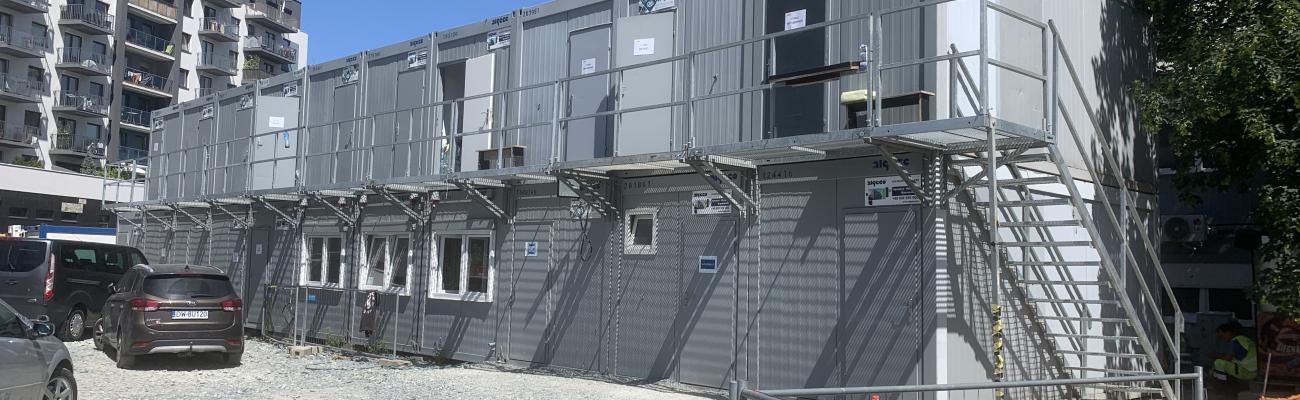

Staff lockers on a building site – how to ensure adequate staff facilities?
On-site facilities at a construction site are not just a matter of comfort, but also a legal obligation under health and safety regulations. A changing room with staff lockers, access to toilet facilities and a place to eat are among the basic amenities that an employer must provide for the workforce. Well-organised facilities have a positive impact on working conditions, staff retention and the efficiency of project delivery. This article explains what the regulations require in terms of staff facilities, how to choose staff lockers and why a portable site office provides a practical, all-in-one solution. It also offers advice on how to quickly set up facilities on a newly opened construction site.
What do the regulations say about staff facilities on a building site?
The organisation of welfare facilities on a construction site is subject to labour law and regulations concerning health and safety at work. The employer is obliged to provide employees with hygiene, sanitary and welfare facilities appropriate to the number of staff and the nature of the work carried out. This includes changing rooms, washrooms, toilets and a dining area.
These requirements are not merely a formality – compliance is subject to inspection, and a lack of appropriate facilities may result in penalties. Importantly, the regulations set out the minimum that an employer must provide. However, it is worth organising facilities that exceed this minimum, thereby improving working conditions. This is also viewed favourably by investors as a sign of the contractor’s awareness in the area of health and safety and process organisation.
Minimum health and safety requirements – changing room, toilet, dining area
Health and safety regulations require that employees have access to a changing room where they can change and store their clothing, to washbasins and toilets, and to a room where they can eat a meal and shelter from the weather. Each of these facilities must be proportionate to the number of employees and maintained to a proper standard of hygiene.
For work where workwear becomes soiled or comes into contact with harmful substances, changing rooms are organised into clean and dirty zones. This layout prevents the spread of contamination and is standard practice in many industrial projects. The number and type of rooms are selected according to the specific nature of the construction site, and the detailed requirements are set out in the applicable regulations, which it is worth familiarising yourself with when planning the facilities.
How many staff lockers for how many employees?
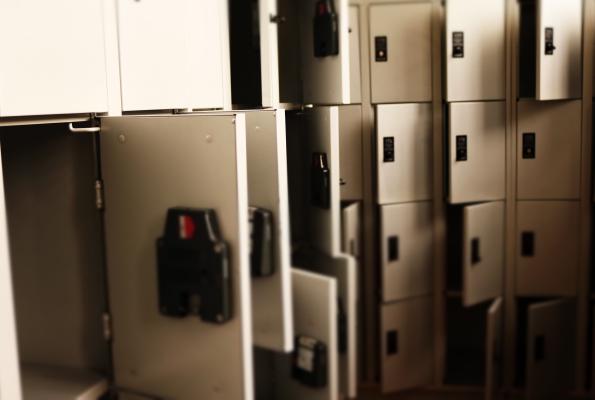
The basic principle is to provide every employee with a place to store their clothing. In practice, this means an individual locker for every employee, and in jobs where workwear is kept separate from street clothes, two lockers per employee are sometimes required. The number of lockers should therefore correspond to the number of employees using the changing room, taking into account shift rotations if the site operates on a multi-shift system.
When planning a changing room, it is worth allowing for a reserve to cater for a temporary increase in staff numbers during peak phases of construction. Underestimating the number of lockers leads to organisational problems and reduces the team’s comfort. The specific number and layout of lockers depend on the size of the team and the available space in the changing room.
Staff lockers – types and materials
Staff lockers vary in terms of the materials used, their design and intended purpose. Choosing the right solution affects the durability of the furniture and the comfort of its users. On a building site, where conditions can be harsh, it is essential that the lockers are resistant to damp, dirt and heavy use.
The basic classification includes single-compartment and double-compartment lockers. Two-compartment lockers, with a partition separating work clothes from street clothes, are ideal in the situations mentioned above, where it is necessary to keep dirty clothes separate from clean ones. The choice of design therefore depends on the type of work being carried out and the degree of soiling of the work clothes.
Metal lockers vs. laminated lockers – which to choose for a construction site?
Metal lockers are the classic solution for staff changing rooms. Made from sheet steel, usually powder-coated, they are durable, resistant to mechanical damage and easy to keep clean. They withstand the demanding conditions of a building site well, and the perforated doors ensure ventilation, which is extremely important for workwear.
Laminated lockers, made from furniture board, look more aesthetically pleasing and are suitable for spaces with a higher standard of finish. However, they are less resistant to moisture and heavy use than metal lockers. On a typical construction site, where durability and resistance to harsh conditions are key, metal lockers are more commonly chosen. Laminated lockers are more commonly found in offices and back-of-house areas with a higher standard of finish.
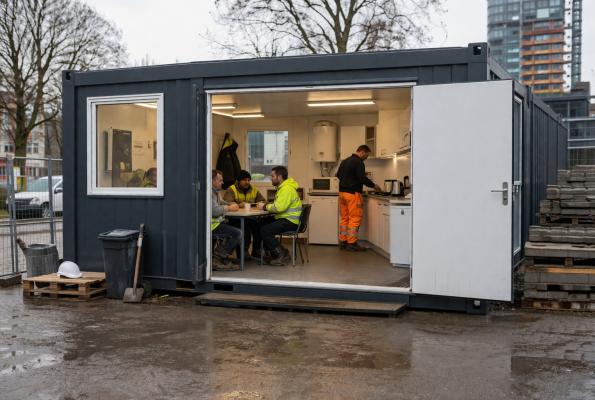
A social container as a comprehensive staff facility
Rather than organising individual support facilities separately, many contractors opt for a site accommodation unit that combines the functions of a changing room, canteen and rest area in a single module. This solution simplifies the organisation of support facilities and provides a cohesive, ready-to-use space. The hire of site accommodation units accounts for the majority of projects carried out by Algeco, reflecting the scale of demand for such solutions in the construction industry.
The site facility container is delivered ready for use, which reduces the time needed to set up facilities on a new construction site. When combined with a sanitary container, it creates a complete set of facilities that meet health and safety requirements. We discuss the organisation of staff changing rooms in more detail in a separate article on the Algeco blog.
What is included in a standard site facility container?
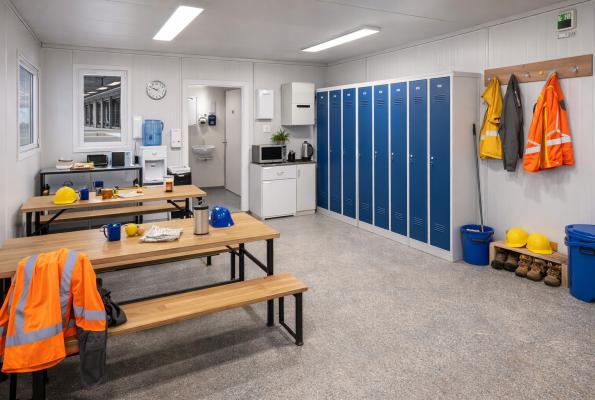
A standard welfare container is fitted with everything necessary to serve as a changing room and canteen – the staff lockers mentioned above, as well as tables, seating, heating and lighting. Staff can change their clothes, store their belongings, eat a meal and rest between shifts.
Algeco fits out its rental containers with furniture and accessories for changing rooms, kitchens and other layouts, and also installs systems specified by the client, such as air conditioning or electrical wiring. This enables us to deliver a ready-to-use module, tailored to the needs of a specific construction site, without the need to source equipment separately.
Accommodation container – when do workers need a place to stay?
On construction sites located far from the team’s place of residence, accommodation facilities are often required. A residential container – that is, a container adapted for living and sleeping – provides workers with accommodation for the duration of the project. Unlike a welfare container, it serves a residential purpose and therefore requires appropriate insulation and fittings.
Residential modules are ideal for long-term projects in locations lacking accommodation facilities. They can be combined to create a base with rooms, a communal area and sanitary facilities. Once the project is complete, the base is dismantled and can be relocated, thereby eliminating the costs of building permanent structures.
How fast can you set up the site facilities at a new construction site?
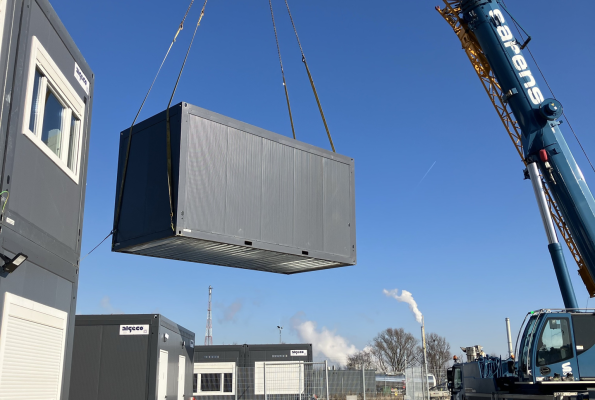
To ensure a smooth start to construction, site facilities must be ready from the very first days of work. The quickest solution is to hire ready-made site and toilet containers, which can be delivered and set up on the construction site in a short space of time. This eliminates the need to build temporary structures and allows work to begin without any delays caused by organising the facilities.
It is worth taking advantage of a comprehensive service from a single supplier. Algeco’s 360° Service covers transport, assembly, fitting out and technical support, meaning the contractor receives a ready-to-use facility without having to coordinate multiple parties. Containers used for the duration of the works, which are not permanently fixed to the ground as structures intended for temporary use on the construction site, generally do not require notification or a permit, which further speeds up the organisation of the site facilities. Once the works are complete, the modules are collected, and the contractor does not bear the costs of their dismantling or disposal.
FAQ – staff lockers on a construction site
How many staff lockers are required under health and safety regulations?
The regulations require that every employee be provided with a place to store their clothing, which in practice means an individual locker. In workplaces where workwear is kept separate from street clothes, dual-compartment lockers or separate storage spaces for both types of clothing are used. The number of lockers should correspond to the number of employees using the changing room, taking into account the shift system.
Does a staff container meet health and safety requirements on a construction site?
A staff container equipped with a changing room featuring lockers, areas for eating meals and – when combined with a sanitary container – access to toilets and washbasins, enables compliance with health and safety requirements regarding staff facilities. It is essential to match the number and type of modules to the size of the workforce and the nature of the work. The specific requirements are set out in the applicable regulations.
How quickly can a site facility container be delivered to a construction site?
Ready-made site facility containers are delivered and set up quickly, as they are prepared for use prior to transport. The exact delivery date depends on the location, availability of modules and the scope of fittings. A comprehensive service covering transport and assembly ensures the facilities can be put into operation efficiently, without delays at the start of construction.
Can a container with lockers be hired as standard?
Yes, Algeco fits out its rental containers with furniture and accessories, including staff lockers, tailored for use as a changing room. The range of fittings is selected to meet the specific needs of each construction site. This ensures the module is delivered ready for use, without the need to source lockers and furniture separately.
How many people can a standard container accommodate?
The capacity of a welfare container depends on its size, layout and fittings. A single module typically accommodates a team of several to a dozen or so workers, whilst combining modules allows for the creation of facilities for larger teams. The number of modules is selected according to the size of the team and the requirements regarding space per worker.