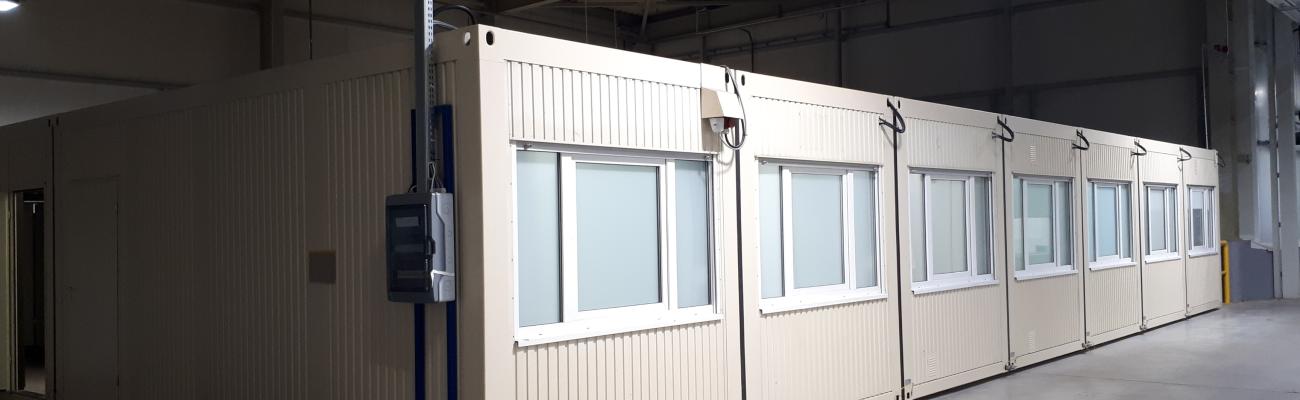

From product to service – how the sales model is changing in modular construction
The shift from selling products to selling services is no longer the exclusive preserve of the modular construction sector. Most sectors of the economy are moving away from asset ownership towards the use of services – from car-sharing and machinery leasing to cloud computing in IT. Modular construction is following the same trend, replacing capital expenditure with operational solutions based on predictable monthly costs.
The traditional model versus the service-based model
The traditional model for procuring modular infrastructure is based on the acquisition of assets. A company buys containers, manages their transport and assembly, fitting out and maintenance, and, once the project is complete, either sells the used equipment or stores it on its own premises. Capital is tied up in depreciating assets, and the company must manage all the logistics and maintenance. The service model changes this approach. Instead of purchasing the product, the company pays for access to ready-made infrastructure – fully equipped, serviced and insured. A monthly subscription replaces the capital outlay, and once the project is complete, the modules are returned to the supplier without the need to find a buyer or dispose of them. Capital remains tied up in business operations rather than being tied up in assets.
Ownership versus access – a shift in priority
Purchasing container modules requires spending the company’s own funds or taking out a loan. The assets are recorded on the company’s balance sheet, are subject to depreciation, and require insurance and maintenance. Once the project is complete, they remain in the company’s possession as used equipment with a declining market value.
The service model shifts the burden of ownership onto the supplier. The client pays for access to the infrastructure for a specified period; the modules do not appear on the balance sheet as assets, and the rental fee is classified as an operating cost. Consequently, the elimination of the purchase cost improves the company’s cash flow.
This distinction is significant, particularly for companies undertaking seasonal or temporary projects. For example, a property developer building a housing estate requires a sales office for two years, i.e. for the duration of the development. Once the last flat has been handed over, the office serves no further purpose. Purchasing a modular unit would entail spending tens of thousands of zlotys on assets that would become redundant after two years. Renting eliminates this problem.

Comprehensive service – from module to solution
A container consists of four walls, a roof, a floor, windows and doors. Transport, assembly, connection to utilities, interior fitting-out and maintenance are separate tasks requiring the involvement of different suppliers. This involves logistical coordination, multiple contracts and varying payment terms.
360° Service offers a comprehensive model. A single contract covers the supply of modules, transport, assembly, furnishing and fitting out, connection to utilities, ongoing maintenance and repairs. The client receives a space ready for immediate use, not a semi-finished product requiring further adaptation.
The added value lies in the elimination of coordination costs. Instead of managing relationships with a container supplier, a transport company, an installation team, a furniture supplier and a technical service provider, the construction company deals with a single entity. Reducing the number of points of contact means fewer potential problems during implementation.
This model addresses the need for cost predictability. The monthly subscription covers all components – from rent through to maintenance and insurance. There are no unexpected expenses for repairs, equipment replacement or emergency technical interventions. The project budget remains stable.
Scalability, or adapting to the project cycle
Construction projects proceed in phases of varying intensity. During the preparatory stage, the workforce numbers a dozen or so people; at the peak of implementation, it rises to over a hundred; and towards the end, it drops back to a dozen or so. Social infrastructure purchased for the project must be designed to accommodate this maximum number, which means there is excess capacity for most of the project’s duration.
Renting allows the infrastructure to be scaled according to actual needs. At the start of the project, three welfare modules are rented; at the peak of construction, ten; and at the end, three again. Costs rise and fall in line with actual usage; they are not rigidly determined by a purchasing decision made at the start of the project.
This flexibility is not limited to the construction industry. Other examples of module use include the events sector, manufacturing and logistics. A music festival organiser rents toilet facilities and catering facilities for the duration of the event. A manufacturer launching a new product onto the market rents a temporary showroom for the market testing period. A logistics company expanding a cargo terminal rents office modules for the project team. In all these cases, the need for space is temporary. A purchase would mean tying up capital in assets that would lose their utility value once the project is completed. Renting aligns costs with actual usage.
Outsourcing management – reducing operational burdens
Ownership of infrastructure entails responsibility for its operation. A heating failure in a staff accommodation container requires calling out a service team, diagnosing the fault, ordering parts and carrying out the repair. Preventative maintenance – inspections of electrical installations, leak tests and cleaning of ventilation systems – requires planning and supervision.
The service model transfers these responsibilities to the supplier. Routine maintenance, repairs, technical inspections and equipment replacements – all of this can be included in the monthly rent. The client reports a fault; the supplier resolves the problem. There is no need to maintain an in-house maintenance team or manage relationships with external contractors.
The value of this solution increases with the scale of operations. A construction firm carrying out five projects simultaneously in different locations would need to coordinate the servicing of several dozen modules spread across different geographical areas. Full-service leasing eliminates this complexity – the supplier manages the fleet; the client uses the ready-to-use infrastructure.

OpEx rather than CapEx – a transformation of the cost structure
The purchase of assets is a capital expenditure (CapEx) – a one-off charge against the investment budget. Leasing is an operating expenditure (OpEx) – a recurring expense covered by the operating budget. A shift between these categories has implications for the company’s financial management.
CapEx requires the availability of capital or borrowing capacity. A company planning to purchase modular infrastructure for one million zlotys must either have this amount at its disposal or secure external financing. OpEx spreads the expenditure over time – instead of one million zlotys in a single payment, the company pays several tens of thousands per month over the useful life of the asset.
This shift improves the company’s financial ratios. Lower capital tied up in assets increases return on assets (ROA). The absence of long-term loan commitments improves the debt structure. Predictable monthly costs facilitate budget planning.
The OpEx model is particularly attractive for companies with fluctuating revenue cycles. A construction firm undertaking seasonal projects generates revenue irregularly. The capital burden of purchasing infrastructure during periods of low revenue worsens cash flow, whilst leasing aligns expenditure with the business cycle.
Risk mitigation – shifting liability
The purchase of containerised modules involves technological risks. Changes to energy efficiency regulations, new safety standards and health and safety requirements – all of these could result in the purchased infrastructure no longer complying with regulations. Bringing it into compliance, in turn, requires additional investment.
Once again, in the service model, this risk lies with the supplier. Legal changes, updates to standards, technological upgrades – the asset owner takes care of all of this. As a customer, you receive infrastructure that meets current requirements.
The issue of technological obsolescence is similar. Modules purchased ten years ago may be functional, but they are energy-inefficient and expensive to operate. Replacing them with newer models or refurbishing them requires a further capital investment. Leasing eliminates this problem – the provider modernises the fleet on a rotating basis; the customer always receives up-to-date solutions.
With leasing, there is also no residual value risk. If you buy modules for half a million zlotys, after five years you might be able to sell them for two hundred thousand. The result? A loss of three hundred thousand. When you lease, you do not incur such a risk – at the end of the contract, you return the modules without having to account for their value.

Sustainable development – resource efficiency
The ownership model also carries the risk of unnecessary overcapacity. A company purchasing infrastructure assumes a scenario of maximum demand and acquires assets based on that scenario. But what if, for the majority of the time, actual utilisation is lower? Unfortunately, this results in a waste of resources. Leasing improves the overall efficiency of asset utilisation, as the provider manages a fleet of modules used by many clients across different cycles. For example, a module that has finished its ‘service’ on one construction project might be sent to a music festival, then to a property developer’s sales office, and subsequently to a temporary medical centre. The utilisation rate increases, whilst the waste of resources decreases.
This efficiency also has a broader environmental dimension. The production of container modules requires materials and energy. The longer and more intensive a module’s life cycle, the smaller the carbon footprint per unit of use. The rental model ensures maximum utilisation of each module, which in turn increases sustainability.
In addition, suppliers are investing in energy-efficient technologies – thermal insulation, photovoltaic panels and WiFi-controlled electric heating. Customers renting the modules benefit from these solutions without incurring any capital costs. Access to modern technologies is included in the monthly rent.
Strategic implications – value chain transformation
The shift from selling a product to selling a service changes not only the supplier’s business model, but the entire structure of the value chain. A container manufacturer becomes an infrastructure operator. Instead of maximising unit sales, it focuses on making the best possible use of the modules and developing services related to them.
Profitability in the product-based model depends on the number of units sold and the margin per unit. In the service-based model, it depends on the length of contracts, operational efficiency and service quality. Success is measured not by production volume, but by customer satisfaction and the stability of rental income.
This transformation requires a shift in organisational capabilities. The manufacturer must develop capabilities in fleet management, reverse logistics, technical servicing and customer relations. Investment is shifting from production lines to IT systems, transport fleets and service teams.
For the customer, the implications are equally significant. The decision to choose a supplier is no longer a one-off purchase transaction; it becomes a long-term operational relationship. Service quality, responsiveness and problem-solving ability – these factors are becoming more important than the product’s technical specifications.
FAQ – Container hire and sales
Is long-term leasing more expensive than buying over the long term?
The total cost of leasing over five years may be higher than the purchase price of the module. The difference is that leasing covers all operating costs – transport, installation, servicing, repairs and insurance – which, in the case of a purchase, are incurred separately. A proper comparison requires taking into account the full cost of ownership of the asset, not just the purchase price. In many cases, it turns out that a fully managed lease is economically competitive with a purchase where maintenance is managed separately.
Is leasing suitable for long-term projects lasting more than three years?
Leasing also works well for long-term projects, particularly where there is uncertainty regarding future space requirements. A company can start by leasing and, after a specified period, decide to purchase the modules at a preferential price that takes into account the rent paid to date. This option combines the flexibility of leasing with the possibility of subsequently purchasing the assets once their long-term utility has been confirmed.
What is the process for returning the modules once the lease agreement has ended?
At the end of the lease period, the supplier organises the dismantling and transport of the modules. The customer is obliged to restore the site to its original condition with regard to foundations and connections. The modules are inspected for any damage beyond normal wear and tear. The return process usually takes one to two working days and is coordinated by the supplier’s service team.
Is it possible to extend the lease during the course of the project?
Most rental agreements provide for flexible scaling of the infrastructure. The customer may order additional modules during the project, and the rent is increased proportionately from the moment the new units are delivered. Similarly, it is possible to reduce the number of modules rented if demand falls. This flexibility in scaling is one of the main advantages of the service model.
Who bears the cost of repairs in the event of breakdowns resulting from improper use?
The lease agreement sets out the scope of the parties’ liability. Breakdowns resulting from normal wear and tear are covered by the supplier as part of the service. Damage caused by misuse, negligence or force majeure may be charged to the customer in accordance with the terms of the contract. In practice, most faults fall within the scope of normal wear and tear and are repaired at no extra cost.