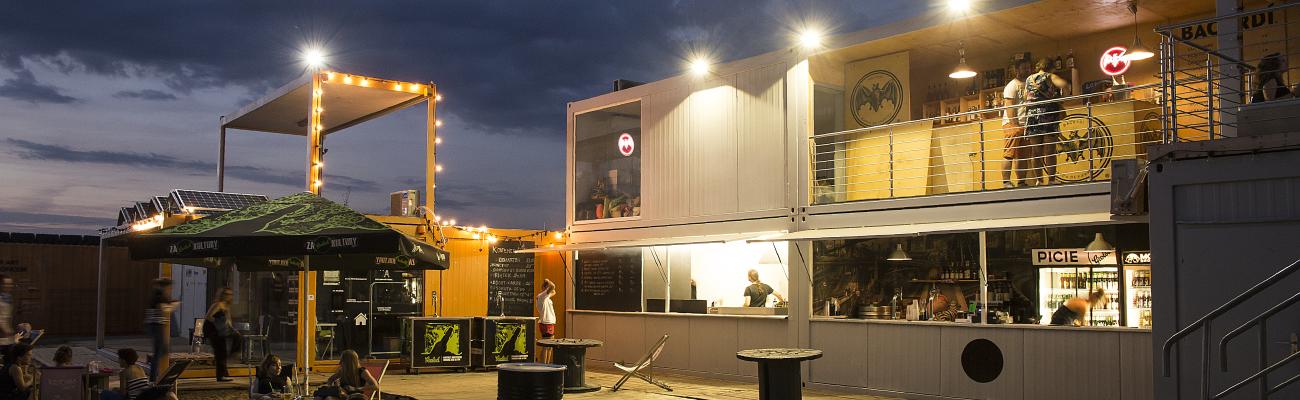

A modular space for the summer – seasonal events in the city and by the water
A defining feature of the events and tourism sectors is their seasonality, which businesses have to contend with. Summer festivals, city beaches and water sports equipment hire companies generate the vast majority of their revenue between May and September. For the remaining seven months, the infrastructure lies idle, whilst fixed costs continue to mount up.
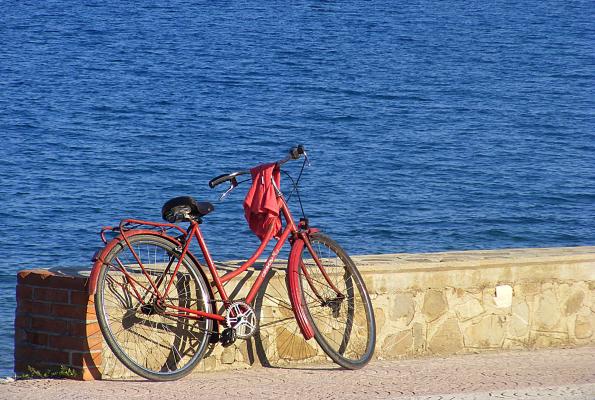
Seasonality in figures: why permanent facilities aren’t cost-effective
The events industry and waterside leisure activities operate mainly, and often exclusively, in the summer. City festivals take place between June and August. Rental businesses by the lakes operate from May to September – it isn’t profitable to stay open any longer, as the number of customers drops significantly when autumn arrives. Summer open-air cinemas and bars in parks operate for a maximum of five months a year, depending on the weather. An entrepreneur renting space for a bar on the Vistula in Warsaw pays rent all year round, but only generates revenue in the summer.
Of course, the owner of a canoe hire business in Masuria could build a brick pavilion, but this is an investment of several hundred thousand zlotys that yields no return for most of the year. Such a solution only makes sense if the facility is used all year round. With just four months of activity a year, the return on such a project is doubtful.
Long-term rental does not solve the problem either, as out of the twelve months’ rent paid, revenue is generated for only four to five. So how can one organise a professional infrastructure that appears in time for the season and disappears when it ends?
Modular solutions provide the necessary infrastructure whilst adapting to seasonal demand – a project comprising containers is erected in April, then dismantled in October, and the fee covers only the actual period of use.
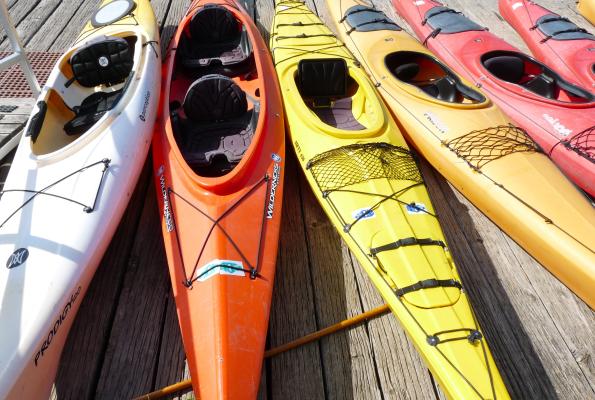
Rental service point: from kayaks to skateboards
A rental business offering kayaks, surfboards, pedalos or kitesurfing equipment needs three things: a space for customer service, a storage area for equipment and toilet facilities. Everything must be close to the water, easily accessible and ready before the season begins.
Reception and equipment hire counter
The reception is where the first contact with the customer takes place. This is where staff take bookings, issue contracts, accept payments and hand out equipment. A space of 15–20 m² is sufficient for a service counter, a till, space for customer deposits and a rack with life jackets. Everything is within easy reach so that serving a single customer takes as little time as possible.
Let’s also consider other necessary elements – during the peak season, the outlet operates from morning until evening, with two staff members working in shifts: one handles rentals, whilst the other takes returns. In summer, the temperature inside a container without air conditioning can reach as high as 35 degrees, so ventilation or air conditioning is not a luxury, but a necessity. The optimum temperature ensures not only staff comfort but also a good first impression for customers.
Equipment storage: from kayaks to stand-up paddleboards
A medium-sized lakeside rental shop handles several dozen rentals a day. This means several dozen kayaks, stand-up paddleboards, life jackets and sets of paddles, all of which need to be stored properly. In the morning, they need to be brought out; in the evening, put away; and the storage area must also be checked throughout the day. One or two modules, each measuring 18 m², provide sufficient space for shelving, kayak racks and a well-organised equipment collection area.
Access is the most important consideration. Equipment is handed out to customers outdoors – on the beach or by the jetty – so the storage facility must have an exit leading directly towards the water to minimise the distance from the handover point to the shore. The interior is a matter of logistics: hooks for paddles along one wall, stands for boards along the other, and shelves for life jackets to the side. In the evening, every item is put back in its place, the door is padlocked, and the whole process starts again the next day.
Refreshment stand: coffee, drinks, snacks
After an hour on the water, customers return thirsty and hungry. A refreshment stand next to the hire centre is often a better business than the equipment hire itself – the profit margins on coffee and snacks are higher than on kayak hire. A catering container with an area of 18 m² is sufficient to accommodate a bar, a coffee machine, a drinks fridge and a microwave. The basic offering – coffee, cold drinks, sandwiches, ice cream and hot dogs – does not require a kitchen equipped with sophisticated appliances.
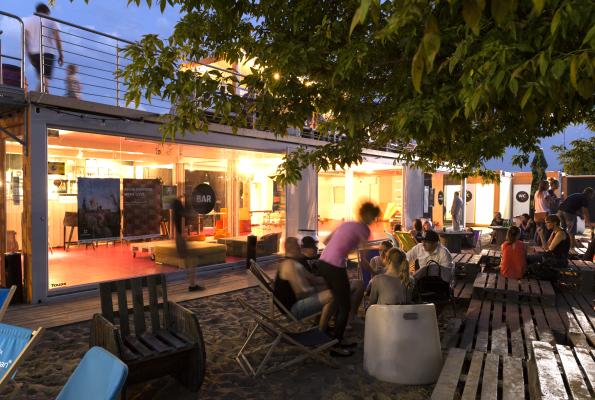
Chillout zone lounge area – this is where customers wait their turn
A town festival, an open-air summer cinema, a food truck area – wherever people spend a few hours, they need somewhere to sit. Rather than spreading blankets on the grass, they prefer to sit in an area with a canopy, deckchairs and tables.
A covered pavilion: shelter from the rain and sun
A festival lasts several hours, and attendees sit and relax between attractions. A covered area with seating is something event organisers often overlook, yet festival-goers really miss it when it’s not there.
A modular structure with open side passages provides shade in the heat and shelter from the rain – simply add tables, chairs and rattan sofas, and the lounge area is ready for use.
How long does assembly take? A day or two. Dismantling after the event is just as quick, and the site is restored to its original condition in no time. This is particularly important in city parks, where any alteration to the space requires approvals and permits.
Toilets: an essential element of any event area
Five hundred people at an event with no toilets within a hundred-metre radius is a scenario every organiser wants to avoid. Portable toilet units solve the problem wherever there is no mains drainage – on the beach, in a park, or in a clearing. A single toilet cubicle with a washbasin and a waste tank is the standard unit that can be set up practically anywhere.
How many cubicles are needed? It depends on the scale of the event. For 500 attendees, you should have around ten cubicles. The units operate without fixed connections – the waste tank is emptied by a waste management company every two to three days, depending on the volume of use.
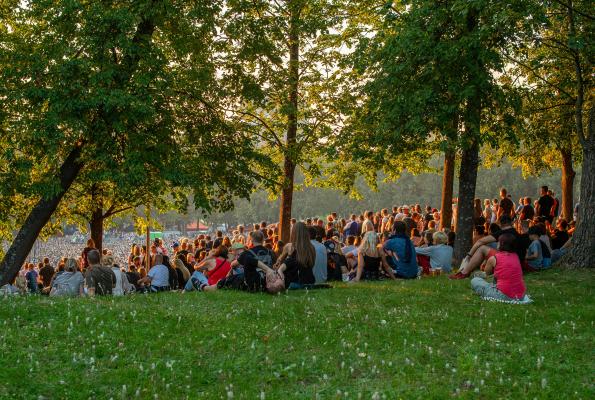
An open-air summer cinema with a ticket office, a refreshment bar and technical facilities
An open-air cinema in the city park is one of the most popular ways to spend time in July and August. The screen is set up outdoors, the screening begins at dusk, and the audience sit on blankets or garden chairs. People attending such events very often buy tickets on the spot, and whilst there they want to have a coffee or tea and use the toilet.
Ticket office and information point
An open-air cinema needs a place where customers can buy a ticket or enquire about the screening time. An 18 m² module with a ticket window, a payment terminal and a ticket printer provides sufficient space for staff. As well as selling tickets, the ticket office also serves as an information point. Questions about parking spaces, bringing in your own food or the rules on bringing dogs are most often asked at the counter. This is the customer’s first point of contact with the event, so it’s worth ensuring the area looks professional.
Popcorn, drinks and snacks stand
An open-air cinema is the perfect place to enjoy popcorn whilst watching a film under the stars. A refreshment stand can generate more revenue than ticket sales alone. An 18 m² unit featuring a counter, a coffee machine, a popcorn machine and a fridge will allow you to sell snacks and drinks just like in a regular cinema.
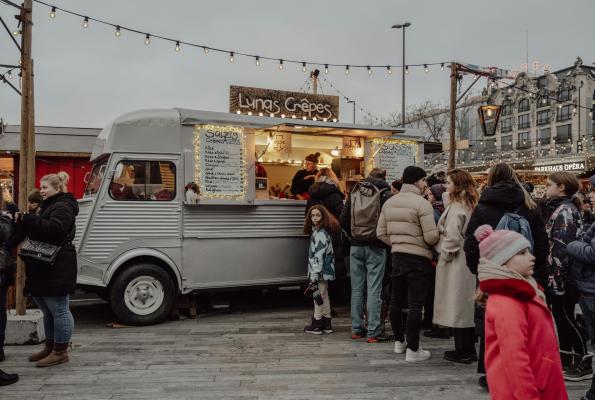
Food courts and dining areas at festivals and outdoor events
City festivals, fairs, concerts – wherever thousands of people gather, there’s bound to be a food court. Usually, this involves food trucks lined up in rows, with customers buying food and then looking for somewhere to sit. Picnic tables set out on the grass are a solution that works well in fine weather, but doesn’t cut it when it rains.
A covered food court: space for 100 people
Event modules with a roof and seating for a hundred people ensure comfort for food truck customers. Whatever the weather, attendees can sit under cover to enjoy their meal in peace.
This area is usually set up two to three days before the event. The cost of hiring it for a weekend is several thousand zlotys, but for the organiser it is an investment that affects how long participants stay at the event and the revenue generated – customers stay longer and spend more on food and drink. The feedback from participants is also significant; they are sure to appreciate an organiser who ensures comfort in the catering area. Satisfied guests are more likely to return to annual events.
Seasonal renting: the economics of four months
An entrepreneur running, for example, a canoe hire business on a lake usually does not want to buy modules that they only need for four months. In this case, the solution is seasonal hire. Algeco delivers the modules in April and collects them in October. The cost is the monthly rent multiplied by the number of months.
A 5-month hire (May–September): a cost in the region of several tens of thousands of zlotys.
Seasonal revenue: several hundred thousand zlotys.
Cost-to-revenue ratio: profitable.
Advantages of renting:
- No need to invest in the construction of a permanent structure,
- Flexibility – the number of modules can be adjusted to suit the scale of the season,
- 360° service included in the price – repairs, maintenance and transport are the lessor’s responsibility,
- No hassle with winter storage.
FAQ – Seasonal events and modular containers
How long does it take to install modular infrastructure for a waterside rental centre?
With a standard configuration (reception, storage area, catering facility, toilets), installation takes 3–5 working days. It is essential to prepare the site in advance – by preparing a hard-standing for the modules and ensuring access to electrical connections.
Are the modules suitable for use in direct sunlight during the summer?
Yes, but they require air conditioning or ventilation. Without adequate cooling, the temperature inside the module in direct sunlight can exceed 35°C, which makes it difficult for staff to work and for food to be stored.
What happens to the modules at the end of the season?
The modules are dismantled and transported back to the lessor’s warehouse. The site is restored to its original condition – no foundations or installations remain.
How much does it cost to hire the infrastructure for the entire summer season?
It depends on the scale of the project. A complete infrastructure for a rental facility (reception, storeroom, catering outlet, toilets) costs in the region of several tens of thousands of zlotys for the May–September season. A specific quote requires consultation with an Algeco adviser.
Does Algeco deliver modules throughout Poland?
Yes, Algeco has branches throughout Poland and delivers modules to any location – from the Baltic Sea to the Tatra Mountains.