

A mobile showroom with a striking outdoor display
An exhibition space that can be efficiently set up and dismantled solves the problem of excessive infrastructure costs. Container modules offer a professional product presentation without the need for long-term investment in property or construction processes lasting several months. Temporal and spatial flexibility replaces fixed infrastructure where the latter is not economically viable.

The developer’s sales point – first impressions count here
A housing development takes several years to complete. However, sales begin much earlier – often right at the building site, when only the foundations are in place. A client arrives to view their future home, but sees only excavations and scaffolding. The sales office must therefore replace the vision with reality – showing floor plans, visualisations, finishing materials and the location set against the backdrop of the surrounding area.
Container modules for property developers function as sales space throughout the entire duration of the development. Inside, they may feature: a reception area, workstations for advisers, or a presentation room with visualisations and design samples. Clients see a professional office, rather than a makeshift table set up under a marquee. This influences purchasing decisions – when buying a flat for hundreds of thousands of zlotys, the client expects an appropriate level of service.
The developer rents the module for two years. Once sales are complete and the development is handed over, the office is dismantled. The rental cost is therefore spread over the entire duration of the project, and the developer avoids having to build a permanent structure that would have no use once the development is complete.

A premium product showroom: a display space in the city centre
A premium furniture manufacturer is opening a temporary showroom in the centre of Warsaw. It plans to test the market for six months – if sales are satisfactory, it will open a permanent showroom. If not, it will choose another city for testing. Renting commercial premises in the city centre costs at least several tens of thousands of zlotys a month, and on top of that, you have to factor in the cost of fitting out the interior and a tenancy agreement for at least a year.
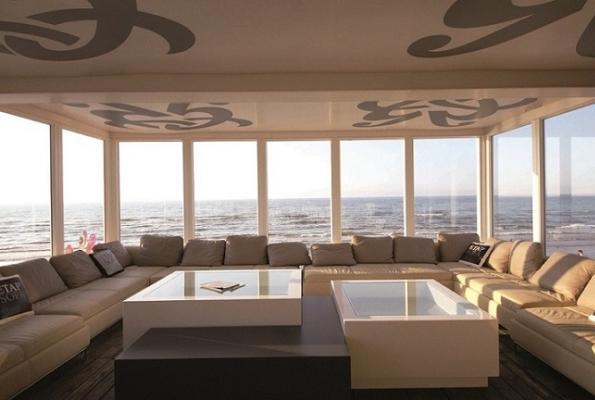
An alternative to this costly investment is a container module situated on a rented car park or in an events area. The interior is designed in line with the brand’s visual identity, the façades are glazed, and the interior features air conditioning and display lighting. The monthly cost of renting the module is several times lower than renting a traditional premises, whilst offering full flexibility – after six months, the showroom can be moved to another location or the market test can be concluded without incurring penalties for early termination of the contract.
This model is very popular with premium car distributors when launching new models onto the market. A temporary showroom is set up in a shopping centre, where company representatives showcase the new car, thereby generating sales leads. After a month, the outlet is closed down. Some time later, the same unit is set up in another town, at a different shopping centre. The company runs a rotating exhibition across a dozen or so locations rather than maintaining a single permanent showroom in one town.

Trade fairs and industry conferences – a mobile exhibition space
A construction machinery manufacturer takes part in five trade fairs a year – in Warsaw, Poznań, Katowice, Gdańsk and Kraków. On each occasion, it requires exhibition space for its equipment, promotional materials and meetings with customers. A traditional trade fair stand is a structure erected for a few days. The cost of a single stand runs into several thousand zlotys. Multiplied by five trade fairs a year, this adds up to a sum that is starting to place a significant strain on the marketing budget.
Event modules offer a more cost-effective and, at the same time, efficient solution. The manufacturer rents a module for the entire trade fair season. The same container appears at all five trade fairs – it simply needs to be transported between locations, without the stand having to be reassembled. The interior is designed once, branded in line with the company’s visual identity and fitted with presentation equipment.
The result is not just cost savings. The exhibition space looks identical at every trade fair, which builds brand recognition. Customers visiting several events a year recognise the company by its distinctive module. This works better than variable stands, which look different every time.

Pop-up shop – seasonal sales with no long-term commitments
A clothing brand is testing a new collection ahead of the winter season. Rather than rolling out the products to all its shops, it has opted for a pop-up store in a shopping centre. The store will run for three months – November, December and January – in a location with high footfall. If the collection sells well, it will be added to the permanent range. If not, it will be withdrawn without any damage to the brand’s image.
A traditional pop-up store requires renting space in a shopping centre, fitting out the interior and installing shop fittings. The cost of fitting out often runs into tens of thousands of zlotys, which may not be recouped over three months of operation. A container module offers a ready-to-use retail space – fitted with shelving, counters, lighting and air conditioning – without the need to fit out existing premises.
The shopping centre provides space in front of the main entrance or in the car park. The module can remain in place for several months to generate the desired footfall. The brand tests the market without any long-term financial or contractual commitments.

Field display of technical products
A generator set manufacturer is unveiling a new model. Potential customers include construction firms wishing to test the equipment in practice – not just in photographs, but under real-world conditions. The showroom at the manufacturer’s headquarters in Szczecin does not solve the problem, as customers are spread across the whole of Poland and are unable to travel several hundred kilometres for a demonstration.
The solution is a mobile showroom that visits the country’s largest building sites. The module is equipped with demonstration equipment, technical materials and a space for sales meetings. A manufacturer’s representative arrives at the construction site and conducts a presentation in a dedicated showroom for a dozen or so subcontractors operating in the area, after which the module is transported to the next location.
This model of a rotating exhibition allows the manufacturer to reach customers where they work. Instead of waiting for them to come to the head office, the manufacturer brings the showroom to them. This generates significantly greater interest than traditional advertising campaigns or sales mailings.

Visual identity in three dimensions
A technology company is launching a new product. The marketing campaign includes billboards, online adverts and press materials. What’s missing is a physical element – a place where customers can see the product, touch it and try it out. A traditional showroom is an investment for years to come, and the product may turn out to be a bad idea.
A container module allows you to create a branded space that is fully consistent with the brand’s visual identity. The façade is finished in the corporate colours, the interior is designed in accordance with the brand book guidelines, and the display lighting highlights the products on show. The visual effect can be exactly the same as in a traditional showroom, whilst the flexibility is incomparably greater.
After a year, either the product is a success and the company opens permanent showrooms, or it is withdrawn from the market. In the first case, the module served as a market test; in the second, it helped avoid a costly investment in infrastructure that would not have paid for itself.

Long-term hire versus purchase – the economics of mobile showrooms
A property developer undertaking three projects a year needs sales offices at each site. Each project takes two years, so at any given time there are two, and sometimes three, offices operating simultaneously. Purchasing modular units costs hundreds of thousands of zlotys – money that the developer would rather invest in land for future buildings than in office containers.
Long-term rental solves the problem of cash flow. The developer pays a monthly rent for the duration of the project, after which they return the modules. A manufacturer taking part in seasonal trade fairs rents a module for eight months – from March to October, when the main industry events take place. The rental cost covers only the actual period of use, rather than the whole year.
FAQ – mobile showroom
How long does it take to prepare a module for use as a showroom?
A standard module can be adapted for use as a showroom within two to three weeks. This timeframe includes designing the interior layout, branding the façade in line with the company’s visual identity, and fitting it out with furniture and display equipment. For more complex projects requiring bespoke architectural solutions, the timeframe may be extended to four to six weeks.
Do container modules meet the requirements for commercial premises?
Algeco container modules meet most of the technical and sanitary requirements for commercial premises. They have building certificates, ventilation and air-conditioning systems that comply with standards, and electrical installations carried out in accordance with safety regulations. Where they are located in shopping centres or city centres, the modules undergo additional approval procedures required by the facility managers.
What are the costs of transporting and assembling a mobile showroom?
Transport costs depend on the distance between the Algeco depot and the destination, as well as the size of the module. A standard module can be transported and assembled within one working day. For long-term hire, transport and assembly costs are usually included in the monthly rent. For a rotating exhibition across multiple locations, the cost of inter-city transport is charged separately for each transfer.
Can the appearance of the module be customised for a specific event?
Container modules allow for the personalisation of both the façade and the interior. For example, the façade can be wrapped in film, an illuminated logo can be installed, or custom colours can be used in line with the brand’s visual identity. The interior can be designed according to individual requirements – ranging from minimalist display spaces to fully equipped showrooms. All modifications are possible for both short-term and long-term rentals.
What is the procedure for installing a module in the city centre?
Installing a module in the city centre requires consultation with the site manager and obtaining a permit to occupy the road verge or public space. Algeco supports clients with the administrative procedures by providing the necessary technical documentation and certificates. In most cities, the process of obtaining a permit takes between two and four weeks. In the case of locations on private land, such as shopping centre car parks or property development sites, the procedure is significantly shorter and requires only the property owner’s consent.